Love, Defiance, and the Highlands: A Conversation with Lisa Rayne
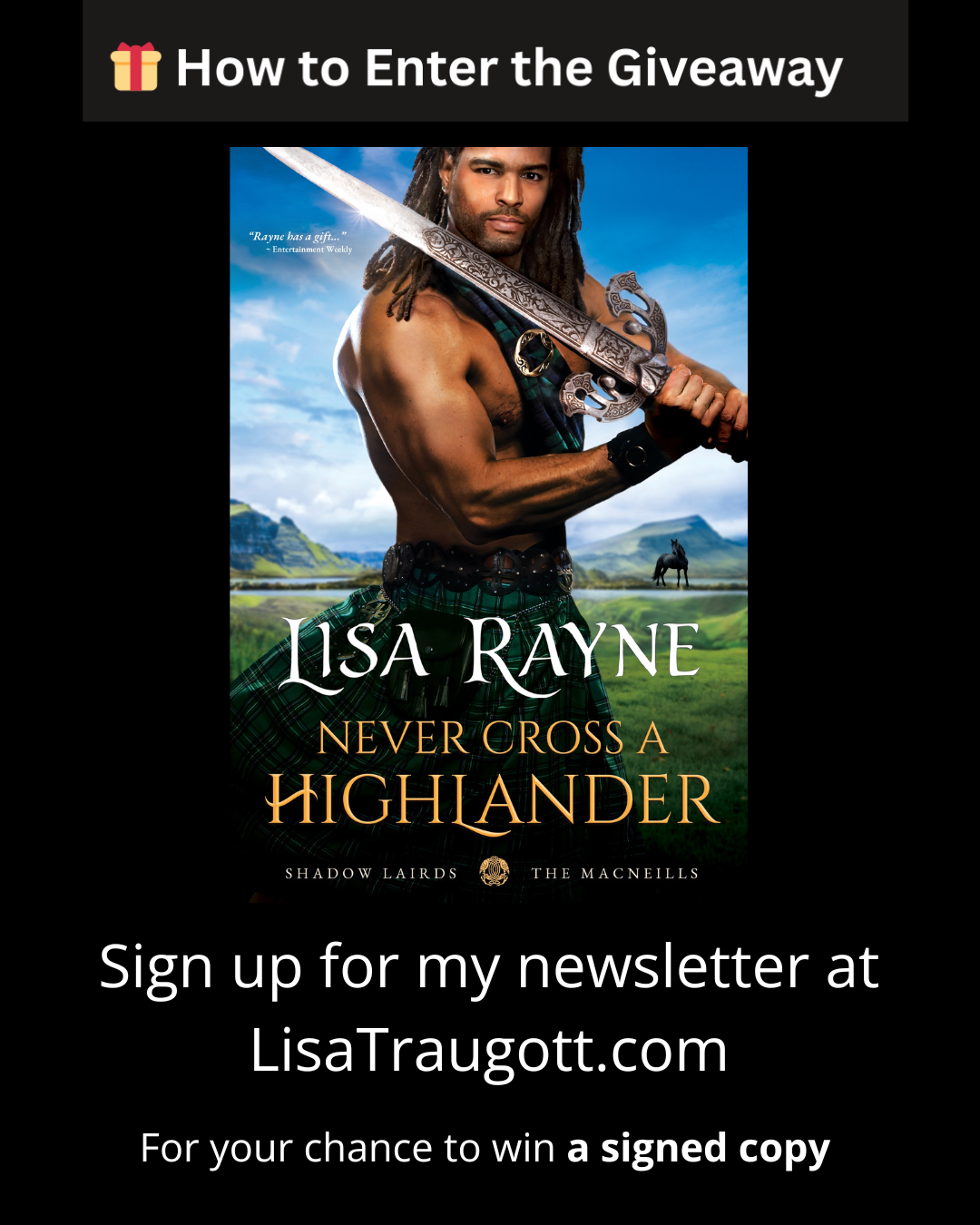
This month’s giveaway spotlight features a romance that has captured hearts for love, courage, diversity, and sweeping Highland adventure. I’m thrilled to team up with Lisa Rayne, author of Never Cross a Highlander, a historical romance that puts Black protagonists front and center in a Highland story rich with intrigue, emotion, and fire-lit chemistry.

Readers have responded to both the sizzling enemies-to-lovers romance and the thoughtful way the historical setting and identities of the characters inform their journey. Whether you’re drawn to bold heroines, captivating heroes, or richly imagined pasts, this book delivers. I asked Lisa to talk about her inspiration, her research, and what it’s like writing love stories that feel both timeless and fresh.
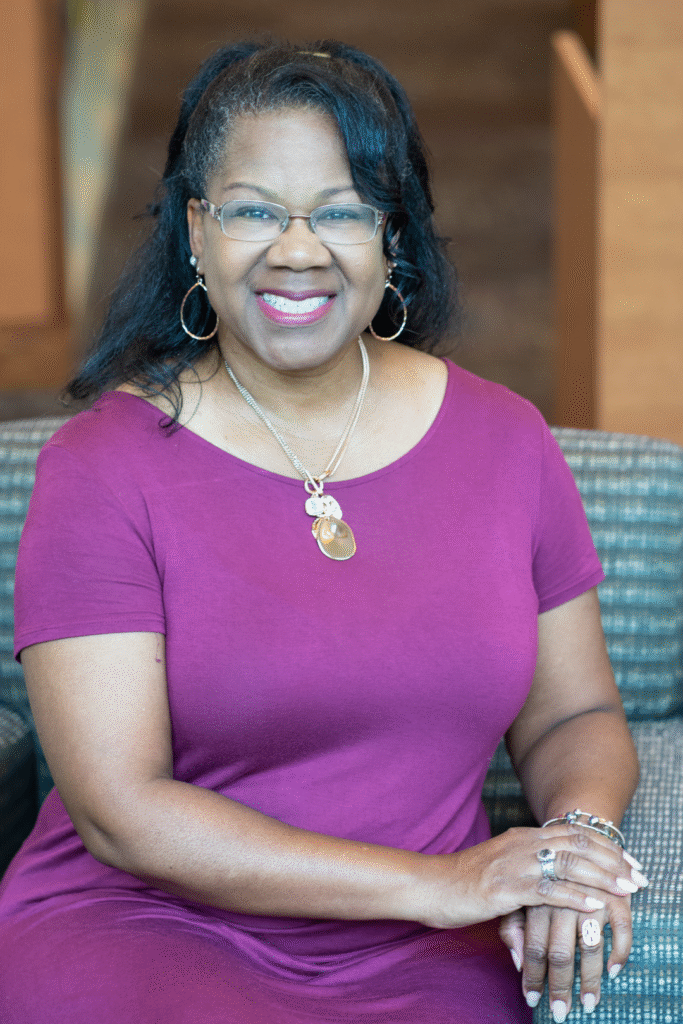
Tell us a little something about yourself.
Before I started writing romance, I worked as a corporate lawyer specializing in intellectual property, media, and entertainment law. Needing to decompress in early 2010 after a corporate downsizing, I found my way back to reading for pleasure and started with my old genre favorite – romance. In between starting my own business, I kept reading and eventually the Comparative Literature major in me awakened and reminded my muse that we’d always thought about writing a romance novel. So I started inching into the romance community and eventually started writing a book.
Writing helps me balance my creative side with my intellectual property lawyer and business coaching alter egos. The corporate side of me merges with my romantic muse to fuel my other passions: advocating for the mainstream distribution of fiction featuring multicultural protagonists and helping creatives become savvy entrepreneurs.
When I’m not writing, advocating, or business coaching, I enjoy being a mom to two GenZ daughters, cheering for the Kansas City Chiefs, and binge-watching planner flip-throughs on YouTube.
Never Cross a Highlander features Black protagonists in a historical Scottish setting, an exciting and less-explored combination in Highland romance. What inspired you to tell this story in this time and location?
I have a certificate in African American Studies from my undergrad alma mater, Princeton University. When my oldest daughter started high school, I had the opportunity to revive the defunct African American History course at her school and became a certified Social Studies teacher for grades 9-12. I loved being able to share the history of Blacks and those affected by the African diaspora with a younger generation who’d had very little exposure to this broader history.
People of color are everywhere in history. It’s important that we not limit historical romance featuring two main characters of color to early historical periods in the U.S. When I decided to write my first historical romance, I really wanted to bring forth a story that centered Black main characters. As a fan of Highlander romances, the lure of writing the tale of a Black Highland warrior was simply too great to ignore.
Ailsa and Kallum grow from antagonists into lovers against the backdrop of danger and struggle. What do you enjoy most about writing enemies-to-lovers dynamics?
There’s something about characters who grow to love each other after initial animosity. To fall in love despite themselves, two characters (and two people) must move to feelings of respect, maybe some admiration, and definitely an understanding. Sure there’s attraction, but attraction without the other emotions is too superficial to lead to lasting love. And making the transition from animosity -> to grudging respect -> to desire mixed with caring is such a fabulous dance to read – and to write.
Your hero, Kallum, leads a secret rescue to free slaves in a Scottish version of the Underground Railroad. Was he based on a real person? What was your creative process in building his backstory and motivations?
Throughout my research, I kept coming across stories of persons enslaved by Scots or Brits who sought their freedom by running away. One story in particular stuck with me about a man who enlisted the Scottish courts to rule on his emancipation and won. That court case was much later in history than I set my tale, but it inspired me to include that aspect of history (the search for freedom) in my story.
Kallum MacNeill is not based upon a particular real person. Abolitionists did exist during Scotland’s participation in the mass enslavement of kidnapped Africans, however, so he is infused with the ideals of those abolitionists. As a fierce Highland warrior with an extreme sense of pride in his heritage, Kallum could in no way be other than a dedicated shepherd to those in need of freedom.
Some of your scenes are very spicy! As a writer, what makes a good spicy scene?
I like to think of spicy scenes as an extension of the character arcs and the plot of a story. How the characters grow into intimate feelings for each other and how they express those feelings are intended to reveal the progression of the storyline. Consider: how the first kiss happens; whether that kiss is tender or passionate; if it starts tender, when does it turn passionate; if it starts passionate, when does it turn tender. There’s also the timeline of when touching advances from casual to vulnerable to completely intimate (or vice versa). These are all actions that showcase not only the advancement of the romance between the main characters but also the plotline.
How characters go from strangers or enemies or friends to lovers, and how that vulnerability or openness with each other develops, will affect the decisions those characters make as each chapter unwinds. Character decisions are the heart of romance. They advance the story and complicate or unwind a plot. So for me, a good spicy scene is not simply about well choreographed and hot sex (though there definitely should be that in a spicy book) but whether when it’s over, the reader has a better understanding of the characters and where their relationship may be headed within the broader scope of the overall plot.
Many reviews mention that readers appreciated seeing diversity in a genre that traditionally skews white. What do you hope readers take away from seeing Black love at the heart of a Highland romance?
That Blacks live and have lived most everywhere on the planet throughout history. The study of disciplines like anthropology and paleontology document the presence of melanated peoples in the 2nd century, and even as far back as the 5th century, across lands such as Greece, Turkey, and of course, Egypt. And these were not servants, but free people of varied and even high-ranking status. So romance novels featuring Black main characters who get their happily-ever-after in locals other than the post-Reconstruction era United States should be at least as prevalent on store and home bookshelves as Blacks are throughout global society.
Readers have praised your historical grounding for these characters. What kinds of research did you do and did you find anything surprising?
I first toyed with the idea of creating a Black Highlander during the summer of 2020. It took a little over a full year to get the story idea from concept to finished first draft. I spent several months on and off doing the basic research (e.g., Highland clans, cultural politics, common weapons, trade and commerce). Delving back into some of my old history books played a role in my research, of course. But since this work occurred at the tail end of the pandemic, a lot of research was done online. The Regency Fiction Writers Association offered a multi-week course on the Clans of Scotland, which I took. The online records and archives of Scotland’s and the UK’s governments offered additional valuable information.
Once I delved into the history of Blacks and Africans in Scotland and Scottish territories and the role of enslavement in the Scottish economy through the early modern era, I knew where I wanted my story to go. One thing I mentioned in my author’s note for the book is my surprise at uncovering the role pirates played in the movement of enslaved people during the historical period in which the book is set. Finding pirate activity within the history of the Scottish offshoot of the African diaspora was unexpected. In hindsight, it probably shouldn’t have been given the huge number of island plantations that were manned exclusively or almost exclusively by enslaved labor. I found this particular unexpected path of research—pirate activity—fascinating.
The journey in your story includes themes of freedom, resilience, and survival. How did you balance the heavier historical realities with the romantic elements of the narrative?
For me, I didn’t consider the themes of freedom or resilience or survival particularly heavy. For many Blacks, colonized populations, and their descendants this is and has been our lives’ reality. Certainly, the nature of how we seek or why we seek freedom or need resilience or survival has varied over generations. Nevertheless, throughout it all, we’ve sought, experienced, and shared joy and love just like peoples who’ve lived without the shadow of centuries of enslavement. It is this story of romance I aimed to tell. Finding your person and lasting love in the midst of—and despite—whatever the world may throw at you.
For readers who picked this up for the romance but ended up engaged with the historical elements as well, what would you say to them about the power of genre-blending?
Those of us who love historical romance understand the power of stories that bring us the thrills and excitement of a thriller or a fantasy or an action adventure novel while set in past times. Readers who love fantasy will relate to the strong world-building used to ground readers in the historical period of a story. Thriller and mystery lovers might enjoy how the limits in technology or medicine or weaponry add additional layers of challenge that wouldn’t occur in modern times. In short, blending genres makes for some powerful storytelling. And weaving history into a tale, particularly, I think makes for an unique and enjoyable read.
What’s next for you after Never Cross a Highlander? Can readers expect more from this world or other stories featuring culturally rich and diverse protagonists?
Thanks to the virality of Black Scottish TikTok last summer, a resurgence of interest in Never Cross a Highlander occurred. Accordingly, I do have plans to revisit this world and publish more stories featuring Black Highlander main characters.
However, my next book (Ice Matched) will be a contemporary romance set in the world of ice skating. Ice Matched is currently scheduled to release late spring or summer 2026. Despite its contemporary time period, the book will include some of the interesting history of Blacks in international and Olympic competitions, like the iconic Debbie Thomas and Surya Bonaly.
I also have several Regency projects in the works. My first Regency-era novel (The Lyon’s Siren) is slated for release in January 2027. To stay abreast of what’s coming next from me, readers can always check the Coming Soon page on my web site.
How can readers follow you?
The best way to follow me is to subscribe to my newsletter. For those on social media, I’m most active on Instagram. And of course, my website is always the quickest way to find out what’s currently going on in my world. So they can visit lisarayne.com.
Additional Contact Info:
WEBSITE: lisarayne.com
NEWSLETTER: lisarayne.com/subscribe
SOCIAL MEDIA: * Instagram *Facebook *YouTube
***
A huge thank-you to Lisa Rayne for sharing her insights and passion for storytelling! If you love rich history and high-stakes romance with characters as thrilling as the Scottish landscapes they inhabit, Never Cross a Highlander is bound to make your TBR list.
And yes — you can win a signed copy in this month’s giveaway.
To enter: Sign up for my newsletter at LisaTraugott.com and reply to this month’s edition with the word “giveaway.”
One lucky winner will be selected and announced in the next newsletter. (US residents only due to shipping costs).