Mystic Symbols: Unveiling the Secrets Behind Cats, Broomsticks, and Witch Hats
As a fiction writer, I do a lot of research into my characters, which means I’ve been studying up on witches.
Set in 1739, “To Rescue a Witch” is about an abused girl accused of witchcraft who must be rescued by a man married to… an actual witch. For Annaliese, the innocent accused of witchcraft, I did a deep dive into witch trials and the legal aspects supported by historical accounts. For Fiona, the actual witch, I researched Celtic pagan traditions, Scottish folklore and read histories about ‘wise women’, ‘healers’ and ‘cunning folk’.

It’s strange to think that people believed in witches but if you were born in a certain era witches were considered real. In today’s world, we see accused witches as vulnerable women (about 84% of the accused were female) but their peers saw them as powerful people to be feared, which was a concept that took me a while to wrap my head around. In future posts I’ll tell you some stories of the accused and the condemned, but today’s post will focus on the witch’s mystic symbols and some theories of their basis in history.
Pointy Black Hat
From the Wicked Witch of the West to popular Halloween costumes, nothing says ‘witch’ faster than a pointy black hat. There are a couple of theories hoe this fashion accessory became associated with witches.
In late medieval times it was fashionable for royal women to wear tall, conical hats called hennins. By the time peasants started wearing them, they became unfashionable and signified someone of lower status. Many of the women were social outcasts, so it stands to reason they would be dressed in older styled clothes.
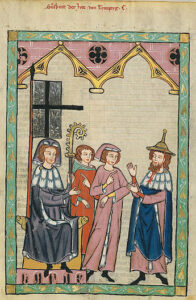
Another theory has antisemitic roots. Throughout Europe Jews were marginalized and in some areas the law mandated they wear pointy hats. The Holy Roman Empire decreed in the Fourth Lateran Council in 1215 that Jews (and Muslims) must dress differently than Christians. Jews were often called ‘Christ killers’ and were associated with evil, much like accused witches.
Below is a painting of Süßkind_von_Trimberg, a German-Jewish poet wearing the ‘Jewish hat’. For further reading and paintings, check out this source: The Librarians – The Origin of the Jewish Hat
The third theory ties to beer. Really. Alewives (women who brewed and sold beer) tended to wear clothes that would stand out in a busy market (like black pointy hats) to make more sales. Beer making used to be considered a female job, but once men got into the business, it’s possible that misogyny and perhaps jealousy with a more successful business woman could have played a part in associating evil doing with these women and their pointy hats.
Broomsticks
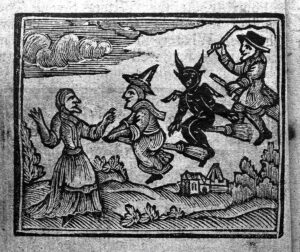
In pagan rituals, a broomstick was sometimes used as part of a cleansing ritual, to sweep away bad spirits. But perhaps the association of broomsticks to witchcraft had more to do with legal testimony. During numerous witch hunts, the accused person was tortured and sleep-deprived until they would confess. Side note – sleep deprivation could cause hallucinations and often times people being tortured will say whatever it takes to stop the pain. Whatever the reason, many confessions of condemned witches included descriptions of flying on a broomstick. Woodcuts, illustrations and pamphlets reflected such testimony. Below is a 1720 woodcut from a book about the history of witches.