Edinburgh is a city bursting with history that hints at ancient magic. Cobblestone streets, mist-shrouded closes, and centuries-old stories cling to every shadow. But among its many secrets, one site near the gates of Edinburgh Castle holds a particularly haunting energy: The Witches’ Well.
This modest bronze fountain, sculpted by Celtic Revival artist John Duncan in 1894, sits quietly at the corner of Castlehill. You might miss it if you’re hurrying toward the castle gates…like I did. Seriously, it took three tries to find the thing! It’s a small basin framed with foxglove and serpent motifs, now softened by flowers. But this spot marks something far darker: the execution ground where hundreds of people (mostly women) were strangled and burned for witchcraft between the 1500s and 1600s.
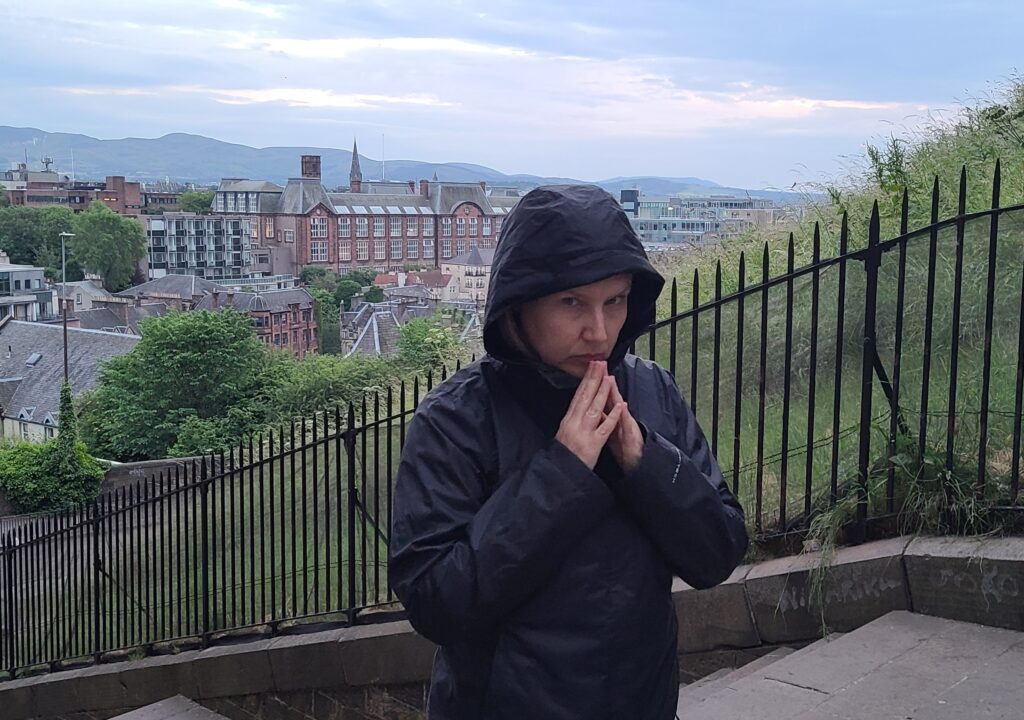
I visited this site during my research for my newest historical novel, To Condemn a Witch. My daughter and I took a virtual walking witch tour, which was fun and interesting. But then I also took a moment, standing in the chilly street as wind brushed against my cheeks.
You could almost hear the echo of whispered prayers. The final words of women accused of consorting with the Devil.
The Duality of the Witch
Did you ever see the movie The Wizard of Oz? Do you remember when Dorothy lands in Munchkin Land and Glinda asks her, “Are you a good witch, or a bad witch?” This idea is based in actual history. Witches were seen as both healers and heretics, wise women and scapegoats.
The plaque above the fountain captures the paradox of witchcraft through history:
“The wicked head and serene head signify that some used their exceptional knowledge for evil purposes while others were misunderstood and wished their kind nothing but good.”
The serpent, symbolic of both wisdom and temptation, slithers through the design, and the foxglove plant, known for its power to heal and poison, represents the duality of all creation.
It’s a message that feels deeply relevant, especially as Samhain (Halloween) approaches — the season when ancients believed the veil between worlds thinned and spirits could wander the earth.
Author Lisa A. Traugott on a witch tour in Scotland
Writing To Condemn a Witch meant immersing myself in the fear and superstition that once ruled Scotland.
As the evening mist rolled down from the Castle Esplanade, I stood in the very place where women once begged for mercy and found none. Many were midwives, healers, or simply inconvenient. Their “crimes” were often nothing more than being different: too outspoken, too independent, too female.
In that moment, I felt their presence, not as ghosts of the past, but as a chorus of resilience whispering through time: Tell our story.
Samhain, the ancient Celtic festival that evolved into Halloween, celebrates death as transformation. When Christianity began to spread through the ancient Celtic lands (making up modern day Scotland, Ireland and Wales) they absorbed, rather than erased many of the pagan fire festivals and turned them in Christian holy days. Samhain became All Hallows Day, hallow being an old English word for saint. The day before All Hallows Day (October 31st) was called All Hallow’s Eve and eventually got shorted to Halloween. This holy day celebrated all souls, the family and friends who passed away.
As a fire festival, Samhain marked the end of harvest season and the beginning of winter. (If you’d like to learn more about the first witch of Scotland – Beira, Queen of Winter – check out this blog post.) Samhain is a time to honor those who came before, to remember that wisdom and power can be both a blessing and a curse.
That spirit lives at The Witches’ Well, and it flows through my Tales of the Witchborn series. To Condemn a Witch explores how easily truth can twist into fear, and how one woman’s courage can spark redemption across generations.
If you love stories steeped in Scottish folklore, ancient magic, and the resilience of women who refused to be silenced, I invite you to step into this world.
Step Into the Magic
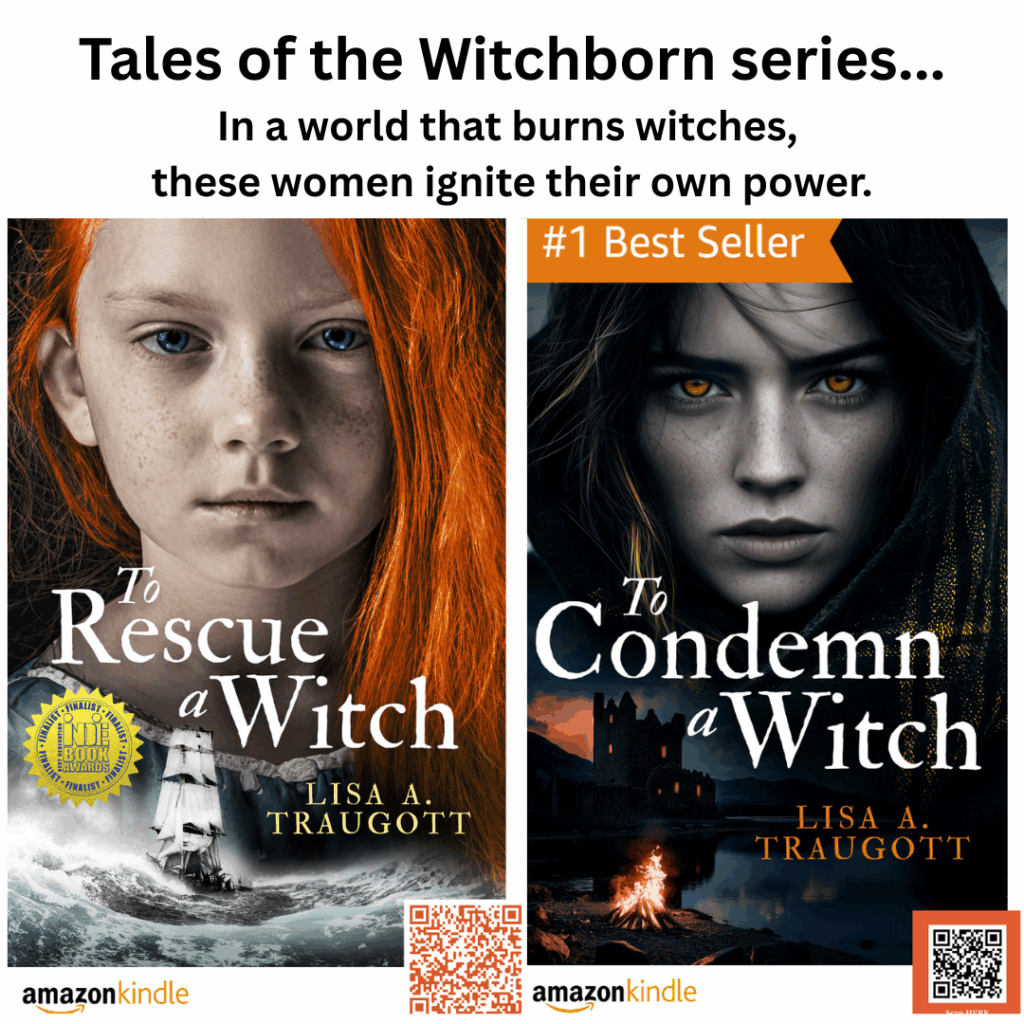
To Condemn a Witch — the prequel to To Rescue a Witch — is available now on Amazon.
Perfect for autumn nights, a cup of tea, and a flickering candle. (Also good with a can of Monster and a chocolate chip cookie, which is more my speed.)
My grandmother’s people came from county Cork, Ireland during the great famine. She had red hair and a fiery temper to match it, but boy could she make you laugh. I remember every St. Patrick’s Day she’d make my brother, Dennis, and me watch the parade in New York and we kept asking where the…
I’ve been fascinated by witches since I was a little girl, which is probably why my novel, “To Rescue a Witch” is about them. Real witches today tend to practice paganism, Wicca and New Age spirituality. In the past accused witches met at the intersection of religion, early science, medicine, fairy tales and entertainment. Here…
As a fiction writer, I do a lot of research into my characters, which means I’ve been studying up on witches. Set in 1739, “To Rescue a Witch” is about an abused girl accused of witchcraft who must be rescued by a man married to… an actual witch. For Annaliese, the innocent accused of witchcraft,…
Did you ever wonder why we celebrate Halloween? Origins The origins of Halloween were in the Celtic fire festival Samhain (SAH-win) marking the end of the harvest season and the beginning of winter, typically celebrated from sunset on October 31st to sunset on November 1st. It was believed that the veil between our world and…
Hey everybody! I’m excited to share a snippet of my next book, “To Condemn a Witch,” which is the prequel of “To Rescue a Witch”. The latest draft just got sent over to my editor this past weekend. Here’s the first draft of what will appear on the back cover, as well as a sneak…
Happy holidays! Did you ever wonder where some of our Christmas traditions came from? If you guessed pagan rituals, you’d be correct. In many cultures across the ancient globe people celebrated the winter solstice, typically December 21st, which was the shortest day and longest night of the year. But it also marks the time when…








One Comment