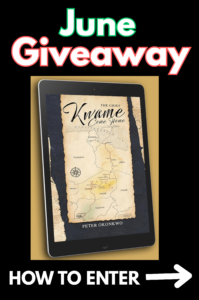
This month’s giveaway is a little different from the historical fiction and fantasy novels I often feature.
Kwame Come Home by Peter Okonkwo is a moving work that blends narrative storytelling, prose poetry, and dialogue into something that feels almost like a stage play. At its heart is a deeply human story about migration, family, loss, longing, and the universal search for belonging. (Details about how to enter the giveaway at the end of this post).
Peter was inspired by real-world stories of African migrants risking everything in search of a better life, but rather than focusing solely on those who leave, he also explores the grief experienced by those left behind. Through the voices of Kwame, his mother Vanessa, and the people whose lives intersect with theirs, readers are invited to consider what “home” truly means.
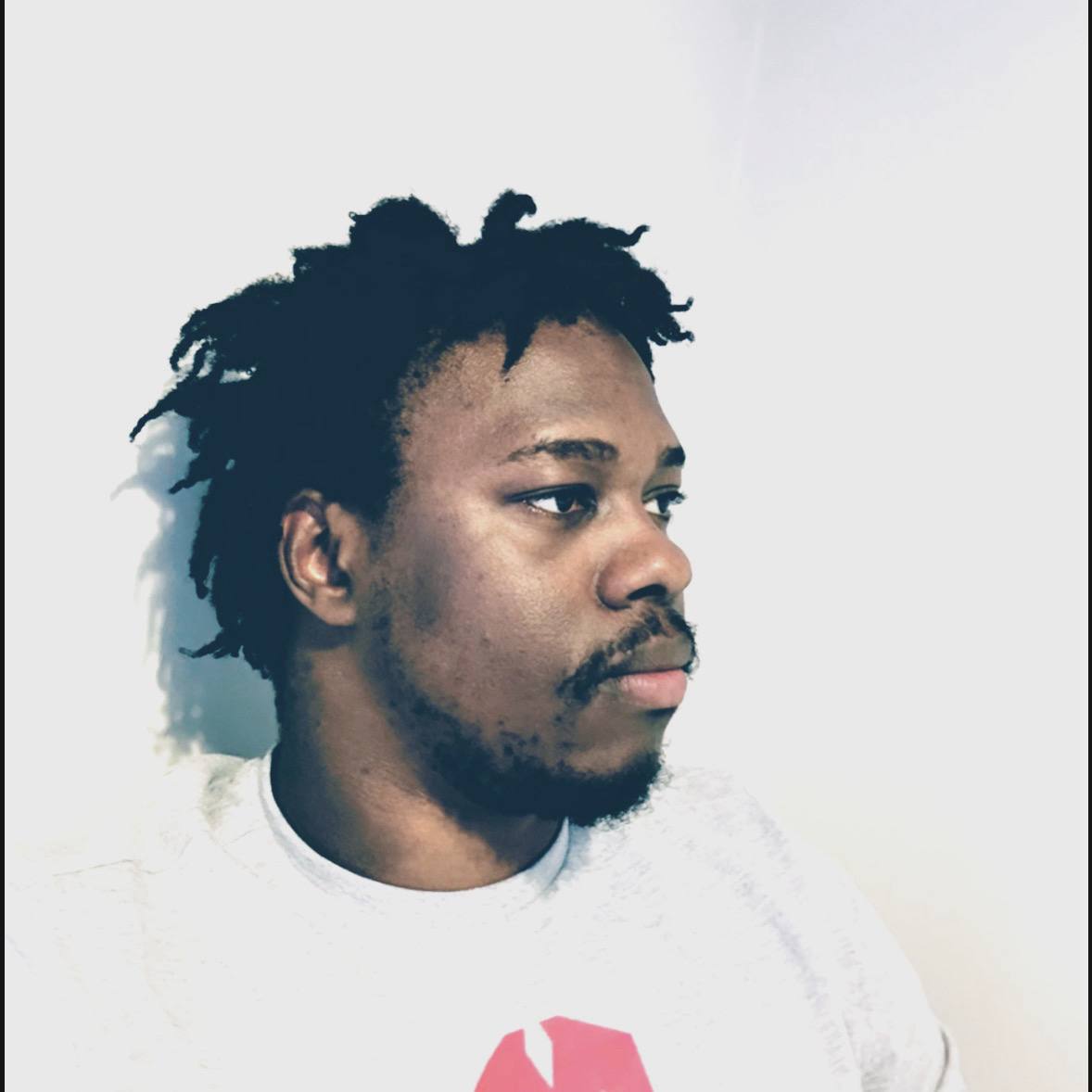
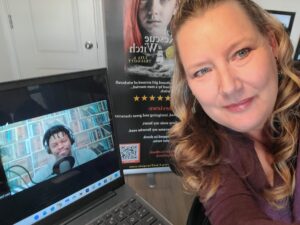
Peter is also the host of the P English Literature podcast, where he has interviewed more than a thousand writers—including me! In the interview below, we discuss the inspiration behind Kwame Come Home, his unique blend of prose poetry and storytelling, the lessons he’s learned from interviewing authors around the world, and his advice for aspiring writers.
To learn more about the inspiration behind Kwame Come Home, the meaning of home, and why Peter chose to tell this story through a unique blend of narrative and prose poetry, I invited him to share his thoughts in the interview below.
Migration, Motherhood, and Belonging: A Q&A with Peter Okonkwo
Kwame Come Home explores identity, belonging, and emotional connection. What first inspired you to tell this story?
I was inspired to write Kwame Come Home after seeing many heartbreaking immigration stories online, how some African migrants viewed Europe as paradise and embark treacherous journey to get there. One of the major things that inspired me to write this story was to explore the reason for leaving, the pain of those left behinds, and also create a shift in perception that these risks are not worth taking, at most times could be life threatening. I understand that some people are forced to leave their countries because of war and other factors. I have also seen many stories of poor families, including desperate mothers who came alongside their babies, all stranded on Mediterranean in search of a greener pasture in Europe. I wanted to tell the story around the current economic hardship affecting some, and if not all African countries, and I felt there was no better way to tell it than through the grief and absence experienced in Vanessa’s story. I was also deeply inspired by the things I see around me. The story of Kwame and Vanessa is so dear to my heart, and many of the characters were inspired by people I know in real life. I wanted to tell not only the story of migration and the pain faced by those who embarked on the journey, but also the pain of those left behind — the mothers, fathers, siblings, and
loved ones who never got the chance to hear goodbye from their fleeing relatives.
Your novel’s title immediately raises questions about “home.” What does the idea of home mean to you personally, and how does that theme shape the book?
To me, the idea of home feels like a safe haven. It is where you are known, seen, and heard. It is where your people are, where you are loved, where
you truly belong. For Kwame, however, home does not entirely fit into these definitions for him. It was struggle entwine in the quest for seeking a good life. For Jide, it was humiliation, as debtors knocks on his mother’s door every now and then. From some of the poems both of them narrated, you could hear their idea of home — “mother cooking millet, the sound of chicks walking around, and the beautiful sense of community that existed there.” But home, to me, feels personal and motherly, and I believe that idea greatly shaped the narration of the book. As you’ve seen in the book as
Vanessa constantly calls on Kwame to return home, to a place where he can feel safe, loved, regardless of its standing challenges. On the other
hand, Kwame has his own reasons for leaving. So, ultimately, home is a place where you feel heard and seen, where you live at peace and are loved wholeheartedly for who you are, and where you feel an utmost sense of belonging.
Many readers connect deeply with stories about family, displacement, and self-discovery. What do you hope readers take away from Kwame’s journey?
I hope that readers take away the depth of Vanessa’s pain, empathize with Kwame, and get to have a view of why he left home. I hope that some of the messages I sought to pass through the book come across undiluted and pure to the readers. One of the things I want readers to take from Kwame’s story is his journey, his tenacity, enduring spirit, his horror, and his “whys” for leaving home. It’s the fact of him being pushed out as an “economic refugee”; as one of my reviewers’ quoted. I’d really love readers to able to resonate deeply with Kwame’s journey, his pain, lamentation, story, his sacrifices, and also empathize with Vanessa while at the same time looking forward to seeing how the story continues in the second series.
Was there a particular scene or character that surprised you while writing the novel?
I think Kwame and Vanessa surprised me while writing the story. Kwame kept showing up unexpectedly and that plunged me into further deep
research of people in similar situations like him. I knew where the story was heading but along the line it went into directions I never thought of. I’m
really impressed with the dynamics of Etean, the switch in characterization of Kwame and his mother, Vanessa. I do think Jide would have his own
switch as well. But I’m particularly intrigued with Vanessa’s characterization. And if there was to be a particular scene that surprised me while writing the book, it will be “Vanessa’s Dire Lamentation” where she talked about how she has waited years for Kwame to arrive, how she stayed outside with her Nokia phone tucked in her bra while waiting for her son to come home because the prophet had told her that her son would arrive on a particular date.
Kwame Come Home isn’t written like a typical novel—it blends storytelling, prose poetry, and dialogue in a way that feels almost theatrical. What inspired this unique approach, and what do you think it allows you to express that a traditional format might not?
While I was writing Kwame Come Home, I wrestled hard the thought of whether it should be an actual novel or a poetry collection. All I’ve written
so far is poetry, because they come naturally easy to me compared to novel writing. I was thinking of a better way of writing it so I first wrote it in a
short story format. But I saw that it wasn’t giving me the authenticity that I was looking for, the rawness of the emotion that I wanted the story to evoke in the heart of its readers. There was this dissatisfaction that came with me first exploring it as a short story, that’s why I had to change it to narrative poetry as I think there’s a level of rawness, emotional evocation that poetry gives that modern storytelling might not convey, especially in the sense of Kwame’s story. I’ve got so many people talk about the dialogues in the book in a way that feels almost theatrical in nature, that’s why most people say it reads like a stage play. I love it that way and I’m exploring prose poetry and narrative poetry so that it could be adapted as a stage play. I believe Kwame Come Home is a powerful work of art, and I look forward to it reaching a wider audience. I truly believe narrative poetry and prose poetry are among the best ways for me to fully communicate the emotions, rawness, and depth of the story in a way that allows each character to feel seen and heard. Just as in the book, every character is given the opportunity to tell their own story, and I believe I achieved that through the
writing style I chose.
Readers often love hearing about the behind-the-scenes process. What did your path from idea to finished book look like?
The path to my idea was quite a journey really. When I first had the idea, it was touching the themes of migration, motherhood, displacement, longing, loss, grief and many more. And as I began to write it, the story unfolded itself in ways that I saw my characters moving in directions I never saw coming. As I progressed, I realized that I could include so many other themes and subject lines that baffle our world currently into the book. Right from the “behind the scene” process to the idea creation. Although the story is not yet complete. Kwame’s story is not finished yet, Vanessa’s story isn’t finished yet. We don’t know if he’s ever going to come home or if he’s going to die on the way. We don’t know what’s going to happen to Etean or Jide or Vanessa herself. Currently I may not be able to answer the question fully because the book is not yet complete and I don’t want to give too much information away, but I think it’s such a mysterious journey really, one filled with a lot of creativity, hard work and a lot of research as well. That’s all I can say about the process.
You also host the P English Literature podcast and recently interviewed me there, which was such a fun conversation. How has speaking with other writers influenced your own creative process?
I think if there’s anything that I love so much about this creative field, it’s the chance of me having to interview lots of authors and writers along the line. I’ve interviewed over 1000 writers from different backgrounds, heritage and culture, different countries and continents, and my interview and
conversation has created a body of literary conversations that many can learn from. So, hearing people come on my show and talk about their books and hearing them share their ideas and their stories with me as a writer has been so inspiring and motivating. Every chat and book talk is a realization for me not to give up, as a creative director and also as a writer. And I think it has really fueled my creativity journey because I’ve learnt a lot from these conversations and interviews that I host. I’ve had professors of literature come on the show and interview that feel like a speech or a lecture. Those interviews are a good resource for students of English Literature in any university whatsoever, so I have benefited vastly and I have gained a lot of knowledge. It has increased my knowledge both in poetry and literature generally. So I’m blessed to be the host of the P. English Literature show and a writer as well.
As both an author and interviewer, what’s one thing you’ve learned about storytelling that all memorable books seem to have in common?
Great question. As both an author and an interviewer, one thing that I’ve learned about storytelling that all memorable books seem to have in common is the wealth of the story embedded in the book. It’s the depth, the emotional connection that the book has in particular. I think great stories
make great books. If you’ve got a great story, a captivating narrative that pulls a reader in until the last page has been read, I think that’s one of the
common features that great books do have. Another thing is the universality of the story, a captivating and spellbinding writing style, in ways that it can resonate with readers far and wide. It could be in any genre. And this also applies when trying to get publishing deal. Whatever story that stays long in the heart of the readers. I think this is one of the things that memorable books seem to have in common.
Many aspiring writers read my Wise Ones Newsletter. What’s one piece of advice you’d give someone struggling to finish—or believe in—their manuscript?
I would say, “just do it,” Just write. If you have a story that you think people need to hear, write it. You need to clear all the self-doubt and do it. Get
your pen down on paper, write the story, look for publishers, and if you want to explore the indie publishing route, do it. Get your work out there, people are waiting to read your work. Be self-inspired and self-motivated. You have to believe in yourself as well, believe in the story you’re telling,
believe the authenticity of it. And while criticisms are helpful, do not listen to the destructive ones, and if it ever gets to you, you need to develop a thick skin and move on.
What’s next for you? Are there more stories, themes, or projects you’re excited to explore in the future?
I am currently working on another book that I plan to release in August this year titled Criers of Stagnation and I’m so dearly looking forward to that. Cries of Stagnation, which is highly philosophical, is expounding on different life issues that makes people cry and offering hope to certain situations of life. It’s going to be highly philosophical, thought-provoking and introspective in nature. I’m also working on the finished version of Kwame Come Home that’s also in my list of things to do. The story of Kwame is still going to continue in the same themes and also explore other themes.
If Kwame Come Home were adapted for film or television, what would you most hope audiences feel after watching it?
I would love the audience to feel Vanessa’s pain, to feel the grief of her longing for her dear son Kwame to come. I’d love the audience to feel remorse for her and also get to understand what it means to be a mother, what it feels to have one’s child disappears for many years without knowing where to find him, and I’d love to see the actors and actresses skillfully enact the characters in the book so beautifully. I’d love for them to see how society treats mothers, especially when they’re grieving or barren, because grief comes in different ways. It could be the absence of what is so dearly desired or the loss of something you once had. I’d also love the viewers of Kwame Come Home to see the depth of human connection, the horrors of stark displacement, the dangers of forced migration, the horrors of illegal border crossing and I’d love them to empathize with Kwame and feel the slight torture that his friend Jide had to go through. I’d also love for them to see the long letters that Etean sent all the years that he had been missing and all those sacrifices that he’s made with his mother Vanessa, during those years as well. I would love to see all the characters brought to life, and I’d love the audience to feel the grief and the tragic nature of the story itself and sort of have a shift in perception of what they think of these economic refugees. I’d also love for them to understand Vanessa, her tears, her grief, her motherly cry, I’d love the beautiful portrait of motherhood to be fully and amazingly portrayed in the characterization of Vanessa. There’s so many things I’d love to see, but obviously I know viewers do have different ways of interpreting what they’ve watched.
***
A heartfelt thank-you to Peter Okonkwo for sharing both his story and his insights.
One of the things that stayed with me after reading this interview was Peter’s definition of home—not as a place, but as somewhere we feel seen, heard, loved, and understood. It’s a theme that resonates across cultures and experiences, and one that sits at the center of Kwame Come Home.
If you enjoy literary fiction, emotionally rich storytelling, or books that explore family, belonging, and the human experience from a fresh perspective, I encourage you to learn more about Peter’s work.
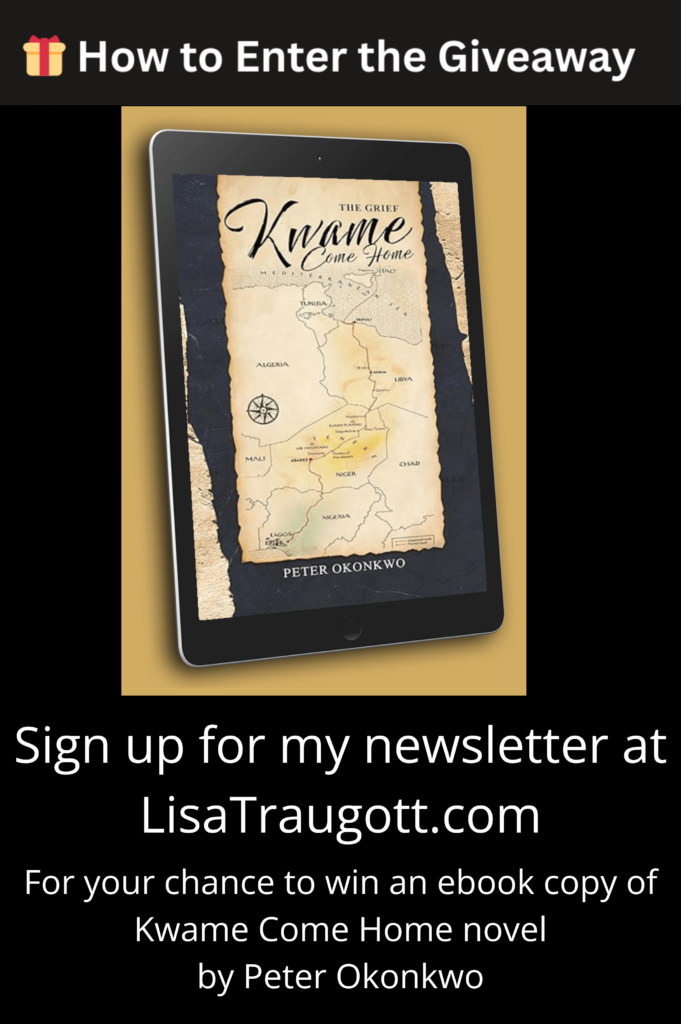
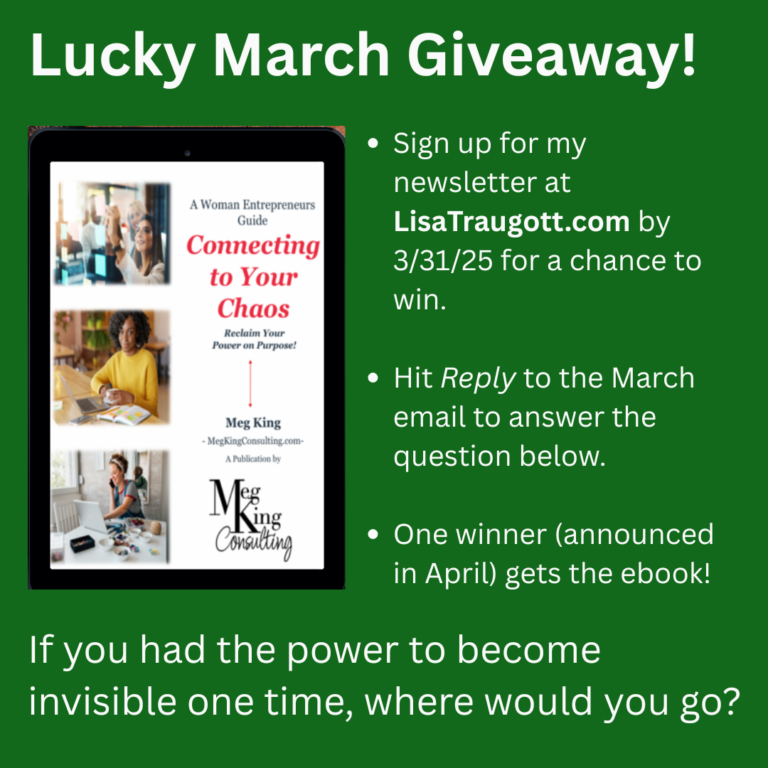
And yes—you can win an ebook copy of Kwame Come Home in this month’s giveaway!
👉 To enter, sign up for my newsletter at LisaTraugott.com and reply to this month’s newsletter with the word “giveaway.”
One lucky winner will be announced in next month’s Wise Ones Newsletter.
Are you a book nerd? I sure am. But where do you think you rank among other readers? If you read just one book, congratulations – you’ve read more than 46% of the American public! According to an Economist/You Gov poll, 1,500 Americans were asked how many books they read last year. “Reading books” included…
Y’all, I’m so excited!!! My book cover is almost done. The big reveal happens in 10 days…which also happens to be the same day I turn 50. If you must admit to being half a century old, at least your designer will be able to present you with your book cover art. I’ve been working…
I wrote this the night before my daughter started kindergarten. Tomorrow she starts college. Here is an excerpt from my memoir, “She’s Losing It!” Good Night Baby/Good Morning Little Girl Tonight I tuck you into bed, your last night as my baby. Your face is sweet and clean and innocent, unmarked yet by the world…
Hey everybody! I’m excited to share a snippet of my next book, “To Condemn a Witch,” which is the prequel of “To Rescue a Witch”. The latest draft just got sent over to my editor this past weekend. Here’s the first draft of what will appear on the back cover, as well as a sneak…
At first glance, a book about business and entrepreneurship might seem far removed from the world of 18th-century witches and historical intrigue. But at its core, Connecting to Your Chaos is about resilience, reinvention, and the power of claiming one’s true strength—much like the heroines in To Rescue a Witch. Just as the wise women…
Howdy friends! Each month I’m aiming to introduce you to some of my indie writer friends and people who read my newsletter get a chance to win great books, like the one you’re going to hear about today. Details about the giveaway are at the end. Enjoy! Lisa: Hi Mila. Tell us a little…